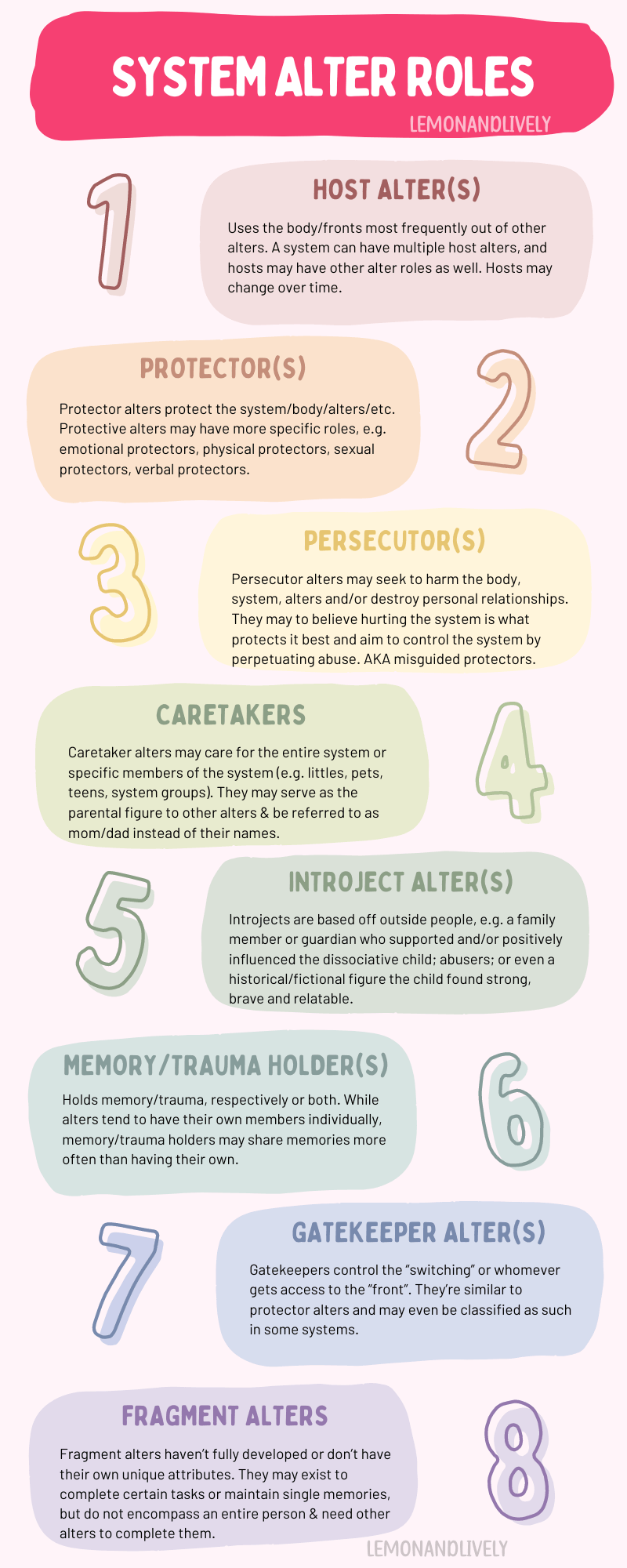
People with dissociative identity disorder (DID) have two or more distinct identities, known as alters.
These alters may have certain roles, purposes or functions.
Alters may also be called
- alternate identities
- dissociative identities
- headmates
- other identities
- otherkin
- other selves
- parts
- parts of the self
- pieces of the self
- self-states
- system mates
DID alters often have special functions, known as alter roles.
Alter roles help people with DID make sense of their alternate identities. Not all systems need roles in order to function well.
Also, there is no “normal” with dissociative identity disorder, because every DID system is unique. Therefore, no definitive list can exist.
This post was written based on my experience learning about DID and living with the diagnosis, after being misdiagnosed due to a medical mimic. Adequate sodium/electrolytes completely removes my dissociative symptoms, turning my whole world upside down.
However, it has helped many people and will remain on my blog.
If you find this post helpful, please it with your friends/followers on social media or save to Pinterest! 💖
Last updated: 27 August 2026.
Types of alters
DID alters can be sorted into two different categories: Apparently Normal Parts and Emotional Parts.
Apparently Normal Parts (ANPs)
Apparently Normal Parts are alters responsible for daily life activities. They’re rational and grounded — integral parts to have at the front.
Responsibilities of ANPs include:
- Feeding the body
- Personal hygiene
- Sleep
- Socializing
- Taking care of other people and/or pets
- Work
Unlike Emotional Parts (EPs), ANPs are present-oriented, meaning they don’t think about the past a lot and are less likely to be triggered.
Emotional Parts (EPs)
Emotional Parts hold traumatic memories and may be stuck in the memory regardless of how far in the past it was.
In other words, EPs struggle to focus on the present because they’re mentally stuck in the sensory atmosphere of the trauma, like a dissociative flashback.
They may experience more depressive episodes, despite the overall system/brain/body not being depressed.
List of DID alter roles
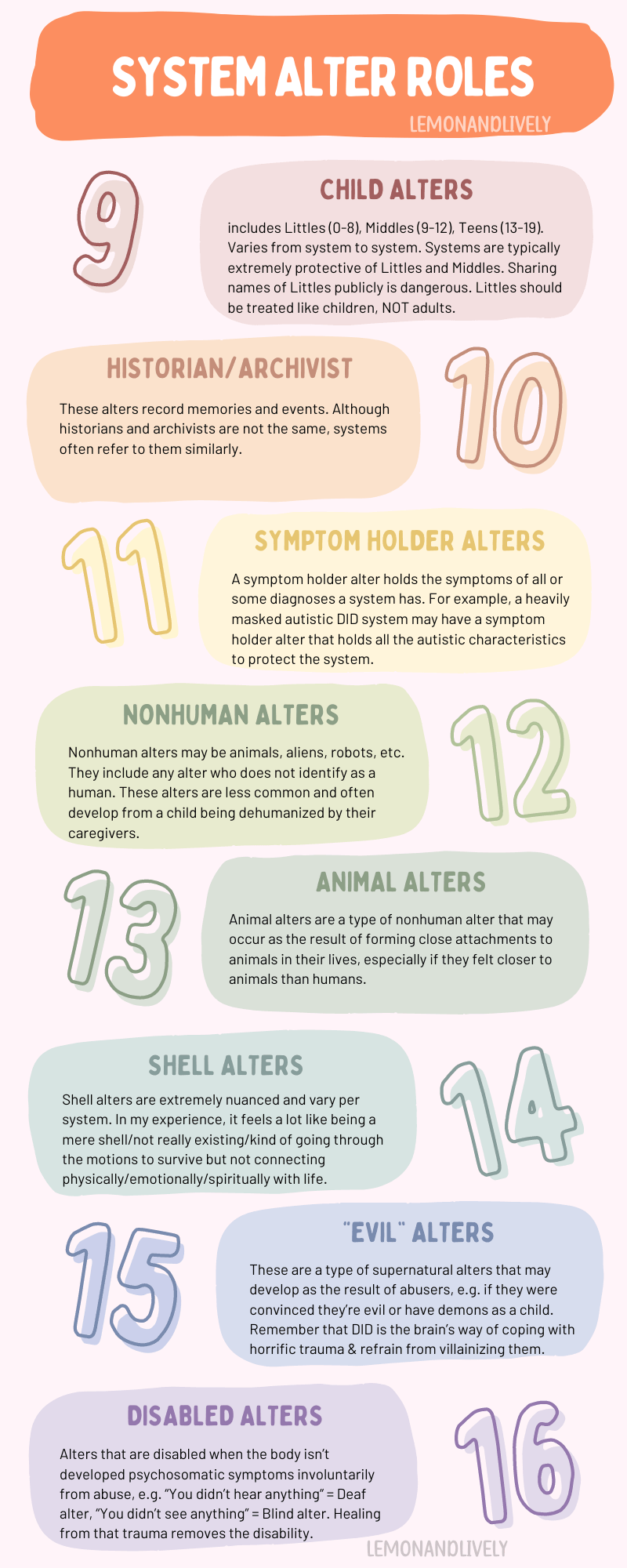
Animal alter
- May be anthropomorphic
- Not uncommon for abused children to befriend animals better than people
People with animal self-states may believe they’re animals because they were treated that horribly or because their pet became their role model.
Angry alter
- Is angry
- May negatively influence other alters to be angry as well
- May be mistaken for a misguided protector
- Heal by acknowledging and working through emotions, and learning how to accept anger as a mood/emotion like it’s a part of you
Caretaker alter
A caretaker alter is a type of protector alter that may care for certain alters or the system in general.
The alters or system may perceive the caretaker alter like a parental figure, and the caretaker alter may consider other alters their children.
Multiple caretakers can exist in a single system. One caretaker may care for each type of alter, or caretakers may care for the system in shifts.
Every system is going to have its own functionality and nuances.
- Cares for specific alters (single or group) or ensures body is taken care of.
- May act like a parental figure to other alters.
Cheerleader alter
Cheerleader alters lift the emotion(s) and/or mood(s) of other alters within a DID system.
Cheerleader alters may have formed due to lack of positive reactions to an individual’s experiences and needs in the past (e.g. caregiver was never happy or always criticized, regardless of achievements).
Child alters
Child alters include littles, middles and teens, and the ages of each vary from system to system.
- Littles are usually 0-8.
- Middles are 9-12.
- Teens are 13-18, but might extend to age 19.
A healthy boundary someone who child alters might create is not sharing the child alter’s name online/in public or with anyone they don’t trust 100% — especially the Littles.
This is because child alters may be triggered more easily by sounds, smells and memories.
Little alters are NOT to be confused with the DDLG kink and should be considered children [by others] when fronting.
During dissociative child states, the person’s mind is like that child state. They are not adults pretending to be children.
However, child alters may have access to an adult brain. This means they may be able to comprehend, speak and behave in a way literal children do not, e.g.
- cooking on the stove or using the oven
- doing laundry
- driving
- using big vocabulary
but this doesn’t always mean they should do all the things and definitely doesn’t mean they are secretly adults.
Child alters may be healed by
- Embracing your inner child by doing things they like
- Inner child healing
- Identifying child alter trauma and working through it
- Identifying child alter triggers and working through them
- Reparenting oneself
- Accepting your inner children as parts of you and being okay with engaging in “childish” activities
Learning about attachment theory, child development and possibly even healthy parenting may help heal your child alters.
Play therapy may be much more effective in working through trauma related to child alters than the typical talking therapy.
Core alter
The core alter is typically perceived as the “original” alter by non-systems and may be used interchangeably with “main alter” or “host”.
Some psychologists still push this alter role, which is problematic — and harmful — because core/original roles add to confusion and misinformation.
DID forms before a child’s identity comes together, therefore there was never any “original” to create parts from. In DID, those parts never came together.
No child is born with all their identities whole.
That said, systems may still have a core alter.
Director alter
A director/manager/leader alter is the director or “boss” of the system and oversees all dissociative states within the body.
A director alter may be active or passive. They may go into dormancy and come out when necessary.
Labels for this type of protective DID alter roles include:
- Director
- Leader
- Manager
- President
- Supervisor
The names of alters vary so much from one system to another because each system uses what they are most familiar with to comprehend what is happening to them.
Disabled alter
Disabled alters are nuanced, in that they may be disabled when the body is not truly disabled.
This doesn’t mean they’re pretending — and it’s not as simple as “mind over matter”.
Abused children who are told,
- “You didn’t see anything,” may develop a blind alter.
- “You didn’t hear anything,” may develop a deaf alter
- “Don’t talk,” may develop a mute alter
Disabled alters may hang out in the headspace, where they disable other alters’ abilities from fronting as typical, or front on their own.
Upon healing from the trauma related to the disability, the disabled alter may no longer be disabled in that way. Healing a blind alter could improve overhaul vision of the body, for example.
Fragment alter
- Not complete/full/whole alters
- Doesn’t have their own unique attributes
- May exist to complete specific tasks or maintain single emotions/memories
Individually, they may not encompass an entire person and need other alters to complete them. In action, this may look like fronting with a complementary alter.
Gatekeeper alter
- May control the switching between alters or who gets access to the front and when
- Some gatekeepers are capable of pulling necessary alters out of dormancy at will
- Some gatekeepers can put an alter into dormancy if deemed harmful for the body’s life
Historian/archivist alter
- Records memories and events
- Terms are often used interchangeably
- System may have multiple historian alters to cover different areas of life/types of memories
Host
- Most frequently fronts within the body
- Doesn’t necessarily associate with the legal name of the body
- System can have multiple hosts
- Some alters want to be hosts more than others, even when it’s not good for the body/system
- Medical professionals mistakenly assume the “host” of someone who has DID is the same as the legal name
There’s this inside joke within the dissociative identity disorder community about each alter wanting to host, but it’s okay if alters don’t want to host, too.
Hosting in a body you don’t identify with or recognize can be uncomfortable and alarming, and it doesn’t make you less of a system (or an alter!) if you have no interest in fronting.
Introject alters
Introjects are alters based off outside people, e.g.
- a family member or guardian who supported and/or positively influenced the dissociative child
- a historical figure the dissociative child found strong, brave, and relatable
- abusers.
Not all introjects are abusive or fictional, or mirror the entirety of those they’re based on or originate from.
Abusive introjects
Abusive introjects bring zero comfort, self-esteem and moral compass to the dissociative system.
They will reenact trauma and abuse to reinforce the “lessons” of their abusers, and may not see themselves as the person they represent.
They may be disgusted by their origin and thus engage in self-harm due to self-hatred.
Fictional introjects
Fictional introjects are common, but do not require the entire character/persona of the fictional person they’ve originated from.
Librarian
Librarian alters perform different tasks per each DID system.
Some DID systems have a “Library of Memories” or equivalent, where books of different memories line the shelves.
Sections of this library may be life stages, attachments, relationships, dynamics, experiences, hobbies, etc.
While the Library of Memories is akin to a library, activities done within the headspace are not as consciously deliberate as in “real life”.
In this case, the librarian alter often knows exactly what memory is in what book. There may be locked sections the librarian doesn’t have access to.
If the librarian has another role, they may have more restrictions placed on them.
Memory/trauma holder alters
Memory holders and trauma holders are often used interchangeably.
Trauma holder alters hold whatever trauma the body has been exposed to. There is no minimum or maximum to how much trauma a DID trauma holder can or will hold.
As the result of holding trauma, a trauma holder might behave similarly to someone with depression. They may be numb to pain or new trauma experiences.
Each alter has their own happier memories, but some alters have less pleasant memories and hold more trauma.
Memory and trauma holder alters may be healed by
- healing from the trauma they hold
- other alters accepting their memories
Non-human alter
Non-human alters may be anything that isn’t human, e.g.
- Aliens
- Animals
- Demon/evil alters
- Dragons
- Fairies
- Ghosts
- Inanimate objects (e.g. a doll)
- Mermaids
- Monsters
Non-human alters may be healed by accepting the characteristics about you that seem non-human.
Observer alter
Observer alters are pretty self-explanatory: They observe.
This can contribute to a state of hypervigilance, as the observer likely developed out of the need for awareness of surroundings, sensory input, other people’s behaviors — the whole environment.
Observer alters may heal only when the rest of the system feels safe enough to not be so hypervigilant. This may take longer than desired, so managing expectations is necessary.
Persecutor alter, or misguided protector
Persecutor alters often seek to harm the body, system, alters, and/or destroy personal relationships and the livelihood of which the body regards.
They may believe hurting the system is what protects it best, so their goal is to control and rule the system through perpetuated abuse.
They may be reenacting trauma, reasoning that more trauma isn’t harmful and will just balance it out.
They may be fearful of good news, good experiences, and even good feelings and seek to stomp it out to avoid hurt/bad feelings.
Some protectors are introjects of abusers and may not understand that they themselves are not abusers.
When healing from trauma, a persecutor alter may be perceived as more of a misguided protector.
Protector

Protector alters protects the system/body. Protectors may be broken down into more specific roles:
Emotional protectors
Emotional protectors may take emotional abuse and/or comfort other alters from the blows of emotional abuse.
Emotionally abusive behaviors include:
- Gaslighting
- Minimizing/dismissing your perceived life experience/concerns
- Invalidating your emotions
Emotional protector alters might come across as stone cold or numb feeling on the outside, but comforting on the inside. They may throw themselves into emotionally abusive situations, because they know they can handle it better than other DID system members.
This does not make the abuse okay and is still a dissociative state as a result of abuse.
Physical protectors
Physical protectors may engage in aggressive behavior to protect or prevent from physical abuse. They also may personally endure physical abuse.
They may react negatively when they think they are going to be hit or experience another form of physical abuse, or simply take it.
For example, a system exposed to beating with a belt might have a physical protector alter who willingly submits themselves to the abuse because they know it’s coming.
This does not make the abuse okay.
Sexual protectors
Sexual protector alters protect the system from sexual abuse by fronting when sexual abuse is imminent. Or they may exist solely for sexual affairs, even if not consensual.
Sexual protectors may also engage in unsafe sex as the result of sexual trauma. This does not take away from their protective behaviors — it is illustrative of their trauma and how trauma affects the brain.
A sexual protector might “willfully” engage with the sexual abuser, in hopes that it will lessen any abuse exposure. This is not consent. Rather, it’s an attempt to feel in control of an uncertain, unsafe situation.
However the body reacts to sexual abuse is not reflective of how anyone feels about what is happening. The body reacts as it does; if you don’t like the feeling, are uncomfortable, and/or do not consent or want to do it — that does not change.
Sexual protector alters in a DID system may also identity as being on the asexual spectrum. The sexual abuse they experience does not negate their personal feelings or experiences.
Verbal abuse protectors
Verbal protector alters protect DID system mates from verbal abuse. They may engage in verbal abuse as well, in attempts to protect the system.
Verbal protectors can also protect Littles and anyone else in the system from hearing something they don’t need to hear.
Pure alter
A pure alter does not have any childhood trauma and may not have experienced trauma until they began fronting within the body more often.
You could also call them a “blank slate alter” or “tabula rasa alter”.
Self-critic alter
A self-critic alter takes the “inner critic” up a notch by being one’s own voice, rather than the inner critical voice of caregivers, friends, etc.
Similar to an abusive introject, the self-critic alter is an introject alter.
Healing the self-critic introject alter requires similar therapy to that of healing the inner critic.
Symptom holder alter
Symptom holder alters might take on the identity of a diagnosis the person with DID has been shamed for.
Instead of singlet masking, an autistic person with DID might have a symptom holder who embodies the autistic behaviors they’re not allowed to do in the presence of other people.
Symptom holders “hold” the body’s disability, mental or physical illness, and/or neurodivergence. There is no minimum or maximum to what symptoms they may hold.
Symptom holders can also hold medical symptoms, e.g.
- acid reflux
- chronic pain
- life-threatening allergies
Since DID forms because of chronic trauma, the alters will form as a coping mechanism. Medical trauma, or symptoms of trauma, may result in a specific alter.
Time keeper alter
People with dissociative identity disorder experience time differently, hence the need for a time keeper alter.
If you’re a system yourself, and you feel comfortable, please share which alter roles your system has! I’d love to meet you! XD
Love this post?
Support me by subscribing to my blog and/or buying me a cuppa: