I hated who I was.
I also didn’t know how to escape being that way.
So I read every self-improvement article I could get my hands on.
I watched Dr. Phil and Oprah.
Bought and read classic books that bored me so I could be “well-read” (but all I got was a reading slump).
Then I stopped cold-turkey after a therapist asked how I’m “sitting with what [I’m] consuming”.
The self-help industry is loaded with projection and encouragement to engage in controlling behaviors.
Rather than staying in your own damn lane, you’re turned into a follower sent off to proselytize the gospel of whatever self-help guru sent you.
And not one of them bothers to help you answer the question of why you are the way you are in a one-and-done way because that doesn’t sell their books.
I don’t have a self-help book. I have a blog.
I also have a mediocre healing journey of my own that I sometimes put into a catch-all laundry basket until I’m ready to sort through it again.
Learn about attachment styles & early childhood development
Attachment styles explain patterns in relationships, emotional regulation and behavior.
Early childhood development teaches you your early childhood experiences did matter.
Together, knowledge in both of these areas help you identify patterns that either
- continued throughout your life or
- impacted you beyond the initial occurrence.
Once you’ve a basic grasp on attachment styles, you can better identify potential attachment styles in other people — without projecting onto them.
Because a lot of “Why am I like this?” questions actually start having answers rooted in your lived experience.
If we practice looking at attachment styles as the base of our being, we can develop self-awareness grounded in an understanding of our
- needs,
- patterns and
- relational triggers
allowing us to respond thoughtfully rather than reactively.
Confrontation without tact is mere volatility.
Understand Maslow’s Hierarchy of Needs
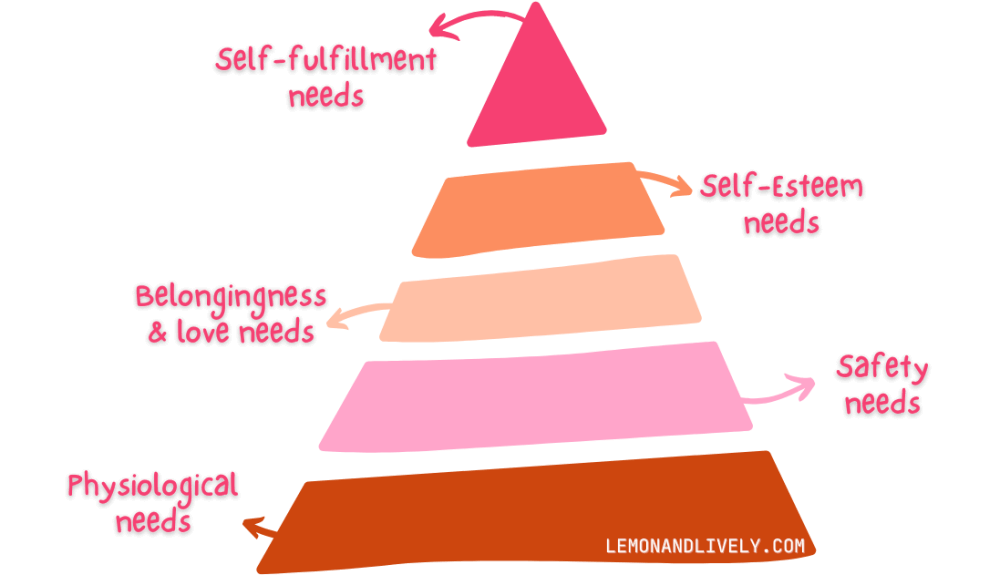
Maslow’s Hierarchy of Needs contextualizes motivation, stability and what drives behavior at different life stages.
Adults may be able to forgo needs higher up on the pyramid for a short time; children, however, are less capable.
They don’t have the capacity for that.
And withholding those needs from them can lead to developing an insecure attachment style. See how this is starting to relate to each other?
Unmet needs manifest in coping, conflict or chronic stress.
And prolonged chronic stress can actually result in chronic illness and/or chronic pain.
In other words, if you sleep on your days off because you’re exhausted — and this has been your pattern for YEARS? It’s not because you’re “lazy”.
Boundaries
Boundaries are the practical foundation of all the theories.
Like, ever.
Understanding early development and needs are only useful if you can enforce boundaries and protect your autonomy.
And I’m not talking about picture-petty, passive-aggressive boundaries meant to humiliate.
Get off my blog with that Regina George BS.
I’m talking about real boundaries.
The kind where you stop taking responsibility for other people’s behavior and start clarifying the cause-and-effect of situations.
Naming the reason for my abuse as “I was abused by abusers/abusive people” instead of “I was abused because I am autistic/was born” was critical to helping me heal from my trauma.
Boundaries helped me stop justifying why people engaged in abusive behaviors.
They helped me stop the narcissistic survival mode I fell into out of fear I’d end up as narcissistic as my egg donor & co.
(The survivor-of-narcissistic-abuse stuck in a narcissistic orbit where I unintentionally centered everything around me.)
(Not to be confused with mirror empathy, a way autistic and similarly neurodivergent people may empathize.)
The best book on boundaries is The Book of Boundaries: Set the Limits That Will Set You Free by Melissa Urban.
There are exercises to help you develop truly healthy boundaries, rather than a list of passive-aggressive statements or control in disguise.
These three set me on a path to what feels like genuine healing.
I know peace from survival mode, which feels like peace until something happens that throws you off kilter and has you spinning like a top in a society of people eager to get out your way.
Moral posturing and performative growth traps feel like healing because that’s how they function.
But at the end of the day, healing is a different kind of exhaustion. Healing brings on a swirl of emotions.
Healing is a state of being, not a stage you step off when you’re finished being there.
Love this post?
Support me by subscribing to my blog and/or buying me a cuppa:

Leave a comment