
I’m over it.
It’s 2025.
I know diversity, equity, inclusion and accessibility (DEIA) is dead in the USA because the current administration and its representing political party considers DEIA too “woke”.
But damn.
It’s 2025.
Ten whole years ago, I was a big autism advocate before I burnt out dealing with autism parents who, despite all the emotional labor of myself and other autistic people, remained closed to the perspectives of people with lived experience.
Because there’s this issue non-autistic people have, where they struggle to step aside from themselves and listen to autistic people — without perceiving what we are trying to communicate in their indirect language despite ours being direct as insults or attacks.
A lot has changed in 10 years, but I feel like everything is going backwards. I’m still here blogging about autism when I’d rather be blogging about watercolor.
Because I can’t sit down to watercolor without catastrophizing and looping — two autistic characteristics, by the way.
So. This is a list of topics I’m tired of talking about, but will talk about anyway until I feel like I have talked about them enough to not need to create more about it.
Ten years from now, I hope to review this post and say, “Wow. We’ve really come a long way! People understand this now! Writing about it wasn’t a waste of my time!”
I should be sleeping right now, but I had such a day that I literally cannot.
So. The list ~
Discomfort around disability
I know able-bodied, neurotypical and/or non-autistic (allistic) people still perceive disability and neurodiversity as taboo, like you need to be politically-correct per the able-bodied perspective of what that is.
They’re really uncomfortable discussing disability. They’re uncomfortable interacting with disabled people and being present around them.
Demanding personal, private information
But something I really, REALLY struggle to understand is the blatant disregard for HIPAA and privacy. This is such a huge part of human culture that we’ve got autistic people online demanding answers to the same questions as non-autistics:
- Are you actually diagnosed, or just “self-diagnosed”?
- What’s your exact diagnosis?
- But were you actually diagnosed? By a REAL doctor? In an OFFICE? Where they have a CERTIFICATE ON THE WALL?! Are you sure they were legit? I need to verify.
???? what in the absolute effervescence is with the commonplace fake-claiming from entitled people on the internet?
Outing disabled people
Another side to this is people sharing about other people’s diagnoses. It can happen literally anywhere — school, work, local Facebook communities or meetups, your relatives talking to their friends…
It reminds me of when I came out and someone sort of adopted my lesbian identity in the name of being an ally while also outing me to everyone they came across and then having the audacity to say, “It’s really homophobic of you to not be out. I don’t know why you’re not more open about it. Everyone is so nice to me.”
(That was a long time ago, and now I just identify as demisexual.)
When you out someone else’s disability without their consent, you take away their agency to decide when to disclose and who to disclose to.
You are taking away their right to manage their own narrative and potentially exposing them to people who will treat them differently. You could also be revealing sensitive information to people they didn’t want to know about it.
You are stripping them of the power and control they have over their own decisions and actions.
People are not your pawns. When you out someone else, you communicate to them that you seek out vulnerable information to exploit for your own attention, gain or sympathy.
Don’t expect the disabled person to trust you again or forgive you so easily, if at all.
Ignorance regarding disability politics
RFK, Jr. wants to create an autism registry for “study” purposes. If you’re familiar with the Holocaust beyond Anne Frank, you’ve likely heard of the Aktion T4 program.
Disabled people were the first victims of the Holocaust via Aktion T4 (i.e. euthanasia). “First They Came” has been reimagined for 2025:
Disabled people are valid to be terrified.
Ten years ago…conversations in autism advocacy spaces — combating anti-autism “autism warrior moms” — focused on our rights to live.
Instead of autism spectrum charts like this one:
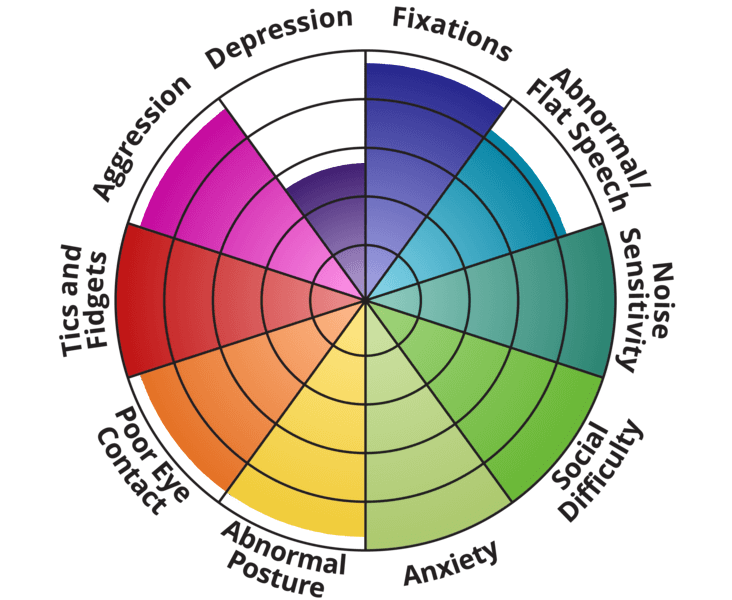
We had graphics that said, “Please don’t murder us.”
We had to explain to people WHY KILLING DISABLED PEOPLE IS WRONG.
Topics that dominated anti-autism spaces revolved around gathering up all autistic people, sterilizing us against our will and without our consent, and shipping us to our own island to fend for ourselves.
Which, really, is a sugar-coated description of eugenics while also being blatant eugenics.
Outing someone’s disability to someone else without their consent is as dangerous as reporting someone you hate at work because you think they’re not “legal” to the icy cronies working for the big, orange man who lives in the big, white house.
I can’t believe I’m having to spell this out.
Anxiety vs awareness of how you’re perceived
I don’t relate to anxiety symptoms in regard to it, because anxiety is supposed to revolve around irrational fears.
What most makes sense for me regarding being perceived is being faced with trauma triggers. Trauma triggers can stir up anxiety, but it’s not specifically anxiety-based anxiety — it’s trauma-based anxiety.
Your body/brain is anticipating trauma, delivering a trauma response, saying, “Hey!! This is an extremely unsafe situation!!”
I know how able-bodied people perceive disability.
- I know how allistics perceive autism and make thin-slice judgments causing them to instantly dislike autistic people and want to avoid them.
- I know how people who aren’t on the D/deaf spectrum struggle to understand how to interact with people who are.
- I know how people who don’t experience sensory overload perceive it as anxiety, when actually our pain receptors are triggered.
- I know how people unfamiliar with the life experience of autistic people perceive autism meltdowns and shutdowns.
A lot of it boils down to the double empathy problem.
And the expectation for people from marginalized communities to perform the emotional labor to help people outside them work through their discomfort and struggle to understand, rather than trying to do the work themselves to empathize.
I’m too autistic for that these days. I spent all my energy keeping myself together so I don’t meltdown on a salesfloor because I am in sensory overload pretty much all the time and cannot escape it.
This post has been in my Drafts folder for ages, out of about 400. I updated it for recency and fell asleep, and a few people thought it “perfect as-is” so 💁♀️ published. I may add to this list over time.
Love this post?
Support me by subscribing to my blog and/or buying me a cuppa:

Leave a comment